Bible Think Tank

This site is designed to help you interact with others about God's Word. I further some thoughts we developed during morning and evening gatherings at church. I have my NT translations from the original Greek to English. Also, I have book reviews and other current events.

Sunday, September 18, 2011

Jesus: on Hell

Intro

In today's sermon, we examine Jesus' teaching on who's in the kingdom and who's out. He brings up the reality of hell: eternal conscious torment of sinful mankind. Below are some resources for you to continue your investigation into this teaching. Feel free to contact me to discuss anything you have concern about.


The Doctrine of the Bible Fellowship Church

Article 26 - The Judgments

26-1. The Scriptures enumerate several judgments that differ in time, place, subjects, and results. All judgment has been entrusted to the Son by the Father.1

26-2. Through the death of Christ on the cross, the believer's sins have been judged, and he has passed from death unto life.2 In no case do the redeemed come again into judgment concerning their eternal destiny. Each saint, however, will be required to give an account before the judgment seat of Christ regarding his works and conduct.3

26-3.The unregenerate will be judged, condemned, and banished to eternal damnation in the lake of fire.4

1 Moreover, the Father judges no one, but has entrusted all judgment to the Son (John 5:22).

2 I tell you the truth, whoever hears my word and believes him who sent me has eternal life and will not be condemned; he has crossed over from death to life (John 5:24).

3 Therefore, there is now no condemnation for those who are in Christ Jesus (Rom.8:1). For we must all appear before the judgment seat of Christ, that each one may receive what is due him for the things done while in the body, whether good or bad (2 Cor.5:10).

4 Then I saw a great white throne and him who was seated on it. Earth and sky fled from his presence, and there was no place for them. And I saw the dead, great and small, standing before the throne, and books were opened. Another book was opened, which is the book of life. The dead were judged according to what they had done as recorded in the books. The sea gave up the dead that were in it, and death and Hades gave up the dead that were in them, and each person was judged according to what he had done. Then death and Hades were thrown into the lake of fire. The lake of fire is the second death. If anyone's name was not found written in the book of life, he was thrown into the lake of fire (Rev.20:11-15).


Article 28 - The Eternal State


28-1. There are two final, eternal destinies for man: heaven for the righteous and penitent, and hell for the unrighteous and impenitent.1 At the great white throne judgment, all of the enemies of God will be consigned to the place of eternal conscious punishment, from which there is no escape.2 The new heavens and the new earth shall be created3 as the final state in which the righteous shall dwell forever in the presence of God.4

1 Then they will go away to eternal punishment, but the righteous to eternal life (Mat.25:46).

2 Then I saw a great white throne and him who was seated on it. Earth and sky fled from his presence, and there was no
place for them. And I saw the dead, great and small, standing before the throne, and books were opened. Another book was opened, which is the book of life. The dead were judged according to what they had done as recorded in the books. The sea gave up the dead that were in it, and death and Hades gave up the dead that were in them, and each person was judged according to what he had done. Then death and Hades were thrown into the lake of fire. The lake of fire is the second death. If anyone's name was not found written in the book of life, he was thrown into the lake of fire (Rev.20:11-15).

3 But the day of the Lord will come like a thief. The heavens will disappear with a roar; the elements will be destroyed by fire, and the earth and everything in it will be laid bare. Since everything will be destroyed in this way, what kind of people ought you to be? You ought to live holy and godly lives as you look forward to the day of God and speed its coming. That day will bring about the destruction of the heavens by fire, and the elements will melt in the heat. But in keeping with his promise we are looking forward to a new heaven and a new earth, the home of righteousness (2 Peter 3:10-13).

4 And I heard a loud voice from the throne saying, "Now the dwelling of God is with men, and he will live with them. They will be his people, and God himself will be with them and be their God (Rev.21:3).

Read our whole Doctrinal statement here


Links

Books

Orthodox

Doctrine: What Christians Should Believe by Mark Driscoll and Gerry Breshears

God Wins: Heaven, Hell, and Why the Good News is Better than Love Wins by Mark Galli and Randy Alcorn

Erasing Hell: What God Said About Eternity, and the Things We Made Up by Francis Chan

Erasing Hell promo video

In Error

Love Wins: A Book About Heaven, Hell, and the Fate of Every Person Who Ever Lived by Rob Bell

The Last Word and the Word after That: A Tale of Faith, Doubt, and a New Kind of Christianity by Brain McLaren


Webpages


If I Don't Preach on Hell by Jeff Hamilton of La Vista Church of Christ

The Teaching on Jesus Concerning Hell by RC Foster

What Did Jesus Christ Teach About Hell? by Kato Mivule

Labels: ,

Wednesday, December 02, 2009

God Became Man

And the Word became flesh,
and dwelt among us,
and we saw His glory,
glory as of the only begotten from the Father,
full of grace and truth.
John 1:14

I was presented this morning with the powerful reality of the Incarnation of God. Incarnation is the teaching that God became a man. This teaching is unique to Christianity. No other faith has the audacity to present God as so humble. Many men have made themselves out to be gods, but no other god has made himself out to be man. This unique and holy teaching is explained by J.I. Packer in his unriveled book, Knowing God. He writes:

"In the thing that happened at the first Christmas, that the profoundest and most unfathomable depths of the Christian revelation resides. "THE WORD BECAME
FLESH" (John 1:14). God became man; the divine Son became a Jew; the Almighty appeared on earth as a helpless human baby, unable to do more than lie and stare and wriggle and make noises, needing to be fed and changed and taught to talk like any other child. And there was no illusion or deception in this: the babyhood of the Son of God was a reality. The more you think about it the more staggering it gets. The mystery of the incarnation is unfathomable."


What immense humility our Almighty God has! The deep swallowing of pride that the omnipotent would be taught to speak! The immense demonstration of love that He would allow Himself to be helpless so that ultimately He could help the helpless to become children of God!

During this busy holy season, take time to reflect on why we busy ourselves. The cliche is that Jesus is the reason for the season. But take time to ponder what He did in becoming one of us. Take time to ponder why He would stoop so low. And praise Him as you do so!

Labels: ,

Monday, November 09, 2009

Where Everybody Knows Your Name

People crave relationship. God infused this desire into our very being. In trinitarian community, God made man and after fashioning Adam in His own image, and this was the first creation that wasn't good. Remember after each day... God said "it is good". But when He made man, He said "it is not good for man to be alone." So God set out to find man a suitable helper. No creature He had made was adaquate to be Adam's partner, so God made Eve. While there is immense and romantic imagery we could observe about husband and wife, we want to simply observe that humans need relationship. We need relationships of varying kinds (Romance, friendship, co-workers, family). It is not good for man to be alone.

Enter our society's answer to this craving. In a culture where good fences make good neighbors and where we do not know the name of the family across the street, we create spaces for friends to gather. Remember the theme song to the late, great tv show Cheers? "You wanna go where everybody know your name." Hopefully it isnt a bar for you, but can you think of a place where you and your friends gather to just be together. I'm a coffegeek and for my ilk, the coffeeshop is the place where friends gather. Howard Schultz, the CEO of Starbucks wants his shops to that special gathering spot for friends all around the world. He calls it what many marketers call it, The Third Place. The third place is that spot aside from home and work where you spend your time gathering. Ray Oldenburg coined the phrase and this is how he describes The Third Place. It is "a generic designation for a great variety of public places that host the regular, voluntary, informal, and happily anticipated gatherings of individuals beyond the realms of home and work." (Oldenburg, Ray. The Great Good Place. 1999. p.16.) These are secular guys expressing the Christian value of community.

So why not the church? Can the church be the Third Place for people craving community? I think so. I believe that the Church merges all the loftiest hungers of the human spirit. Think of it: the Church experience merges relationship, celebration, self-betterment, and spirituality all in one place. People look for these elements to life in a variety of other pursuits but they are all waiting in the one place so many people don't want to look.

As you experience Bethany, ask yourself how you can make it your Third Place. Ask yourself how you can make it someone elses's Third Place. As we find fulfillment within Christian community, let us give God the glory for His redeeming work of making His Church a family!

Labels: ,

Thursday, April 17, 2008

The Relevant Church

a re-review of "The Relevant Church: A New Vision For Communities Of Faith" by various authors.

I've had this book for a while, but I just recently picked it up again and read from a few selections. Essentially, each chapter is written by people in the trenches doing ministry in unique ways. It is not so much the methodology that is unique as it is the philosophical underpinnings (which drive methodlogy) that makes this book and the approaches in it a challenging, refreshing, essential tool in the transitioning society we find ourselves in.

I'd like to interact in this post with a paragraph in the chapter written by Dustin Bagby, a pastor at Mosaic in Manhattan, NY. He writes:

Unfortunately, many people who have grown up in church were taught to avoid culture at all costs. They were taught that we need to form an enviornment
in which to live and then invite other people to join. the problem is that the people who we are inviting to join are not coming. Now it is time to go 'out there' and meet them. I find that most of Jesus; teachings are about going and harvesting. I hear very little about sitting back at an event and hoping people who are not followers will attend. Jesus always went to where the people in need were.

Week after week, we pray for God to bring visitors to our church and that rarely happens. The time is over for churches to expect the unchurched to pop in to find God. They are finding what they think is meaning elsewhere. Certainly, what they are finding will not satisfy long because only Jesus can fill their deepest longings. But too many generations have separated the lost from churches. It was subtle in the beginning... devoted Christians would take kids to church, but those kids didn't find it relevant so they bowed out until those kids had kids of their own. Then when they had kids, they took their kids to Sunday School and maybe morning worship. Then that new crop of kids bowed out with mom and dad when they were too old for Sunday School to hold their affections. By the time those kids had kids of their own, maybe they'd drop off the new generation of kids at Sunday school or maybe grandparents would take the grandkids. What we face now is that twenty-somethings and thirtysomethings are having kids but never consider church as any kind of option because the fact is, they never went themselves as kids. Higher and higher percentages of the younger two generations have little or no church experience.

And so when we today within the church pray for people to come and wonder why our prayers go unanswered, God is conversely wondering (Antrhopomorphism... God can't wonder, He is omniscient) how long it will take for us to figure out that the lost are just that: LOST. They can't find us, they don't know that they need us, it isn't they reject Jesus but rather that they've never heard there was a Jesus.

Labels: ,

Monday, April 07, 2008

A New Kind of Church

All of this got started when the truth hit me like a ton of bricks: we really don't have a coffee shop in Dover. Yeah there's a Coffee Beanery at the food court in the mall, but that isnt a cafe. Yes there are Starbucks at at least two grocery stores in town, but those aren't cafes. There is a place at lawyer central but I haven't been there yet... I think its a deli, but I'll give it a try.

And then the self-pity kicked in... Smyrna has two on Main Street. Milford has two on Main Street. Our town is like double the size of those two towns... what is up? Matt B tells me there used to be one in Dover, so what is our problem?!? We don't drink coffee? Where can I sit with a laptop or a book or some paper and just read... write... talk with people?

So I started to dream. I came full circle to the realization that a coffee shop is not really economically viable. I read a guy on Slate that says to break even you'd have to sell $500 a day in coffee AND work it yourself full time along with your parttime help. He couldn't do it in Manhattan, I don't think I could do it in Dover. That is a mess of coffee to unload per day.

But it got me thinking about church. The first church met in the upper room of someone's house. Acts 1 tells us that 120 of Jesus' followers met continually awaiting the gift of the Spirit. They hadn't bought their own building. They probably weren't even renting, the owner just let them hang out up there. No, I'm not advocating house church, but I think it is worth having a discussion of rethinking church methodology.

I'm just throwing this idea out there: how would you do church on Loockerman Street? What would it feel like? Think upper room. Convert the apartments on the second floor of a storefront into one large room for congregational gatherings. You'd plug it as "the Upper Room." The main floor storefront would be a coffeeshop, bookstore, whatever. Obviously the symbiotic relationship would defray the expenses related to being in that district. Additionally, you'd have the name recognition of the store when telling people about worship gatherings. Most importantly of all to ask: What kind of people would come to that kind of church? Why would that kind of person NOT come to a "normal" church?

I'm not suggesting that we stop doing "normal" church, I'm floating the idea of doing this new kind of church in addition.

Tomorrow? No way! Down the road? Why not. Really, I'm just asking the question...

Labels: ,

Tuesday, March 25, 2008

The Experiential Church

What a fun, meaningful, inspiring, God-centered week! Yeah I'm still exhausted but I just gotta say how encouraging it has been to see people growing in their love for Jesus because of the week's worship gatherings. The collection has been a real evolving work-in-progress for us and this year it really hit me how much more significant gatherings are when they are experiential.

Our VBS has been using Group's curriculum for a few years now. We've noticed that kids LOVE the Bible times more with this curriculum than with others. We obviously want them to love every station, but we certainly want the Bible lessons to be remembered and put into practice. But why do they love Bible time? It is experiential. The kids DO the lesson, not see it, not hear it, they themselves DO it. Can it work for adults?

Once adults move beyond the immediate inner groan of "is he really going to make me do this?" They truly do retain more for a longer amount of time and it means more to them for the long-run. This doesn't eliminate the preaching ministry of the Church, but it does tell me that if I can get people to involve themselves somehow in the Word, it will benefit their walk with God more than merely listening could.

Another word about marketing the Church. I hate the word, you hate the word, but you get my drift... when I tell someone about our Easter gatherings, what makes ours stand out from any other one? There is a church in town that does a phenomenal play/musical every Christmas and Easter. This is the first year I have noticed other churches advertising a play at their church too. Why would I steal another church's idea and do it poorly. I don't have actors, so it will stink. We're doing something, somethings, that no other church is doing. I had a good talk with one of our elders about marketing this corner-on-the-market for next year. Its a great idea.

Here is the rub. Why does it have to be special seasons that we get experiential? If we do it all the time, it loses its edge. If we do it once annually, it communicates that we can only be edgy occasionally. People want to be loose / cutting-edge / different / in-the-unknown occasionally.

I'm just throwing ideas out there. Just rambling really. Rap with me if you want to engage on the issue. I guess it would be good to go over WHAT we actually did. I'll post later about that. I just didn't want this blog entry to be too long.

Labels: ,

Wednesday, February 20, 2008

Fellowship News Article

T H I S I S S T I L L J U S T A D R A F T

Two articles have gotten my attention recently in Fellowship News. The first is “A Missionary Mandate for the 21st Century” by Colby Weinhofer (Sept 2007 and Oct 2007) and the second was “Having Missional Impact” by Dave Gundrum (Dec 2007). Without restating what these brothers have already written, I’d like us all to continue the conversation our denomination needs to have about effective, longterm outreach to our spiritually dead neighbors.

Our Fantastic Message

I believe that the Church has a phenomenal message. What Jesus brought to humanity is a beautiful thing. Namely, that I the rebel against God have received mercy by a lovingly gracious Creator. In that mercy, God satisfied His wrath against me by punishing His one and only beloved Son, who is our Savior, Christ Jesus. Not only has He soothed His anger against me, but He has brought me into His family, put His Spirit in me, declared me righteous, and continually makes me more like Jesus until the day He takes me home to be with Him forever. What a truly fantastic and (in many ways) unbelievable message!


Let’s Get The Job Done

In many ways, the Church is like the Jamaican bobsled team that has found itself broken down only a few meters from the finish line. We, who alone in the world have a great and lasting message of hope from God to mankind, have only a few steps to go before we finish what Christ commissioned us to do.

While we have only a few steps to go worldwide, it seems that the Church is losing footing in areas that once were shored up. Europe, once the bastion of Christianity, has thousands of beautiful, empty church buildings. New England, once the home of the Great Awakening and her sequel, now is a very spiritually cold area. America, wherever you turn does not seem very Christian. While much of the missional conversation discourages us with the onslaught of terrible statistics, I would like to encourage, uplift, motivate, and otherwise stir up our spirits.

At last, our job is nearing completion. Let us not grow weary in well doing. Let us send out our finest and brightest to the uttermost in missionary service! Let us plant Bible Fellowship Churches where Christ’s light in a community is all but snuffed out. Let us talk with our neighbor about Jesus. Let us stop merely memorizing that verse and begin to live it when Jesus said “let your light so shine before men that they would see your good works and glorify Your Father who is in heaven!”

Where the Rubber Meets the Road

I am convinced that our hesitancy in outreach is all about the “how.” We know the “why” of outreach. We know the “what” of outreach. We need work on the “how” because we do not want to look like door-to-door salesmen or cult members and we do not want to sell Jesus short of all the majesty and glory that is due to His Name. So the “how” is important.

There is a two-pronged approach to effective outreach. First, there needs to be church-wide outreach activities. We need to run events that are both “safe” enough that unbelievers will come and “safe” enough that our people will invite outsiders in. These events ought to have some perceived-needs addressed. Financial seminars, sports ministries, support groups, soup kitchens, and countless other ministries are perceived-needs-based ministries that let a spiritually sick and dead community know that we care and want them to be made whole.

The other, equally important, prong of effective outreach is one-on-one discipleship. All of us need to know our neighbors. We need to care about our neighbors. When you hear them fighting, let them know you pray for them. When your kids are in soccer league together with theirs, sit with them at the game. Have them over for dinner, let them return the favor. Be with your neighbors. This is, after all, what the Almighty God did when He took on flesh and dwelt (tabernacled) with us. “You shall call His Name Immanuel which translated means ‘God with us.’” People want to know that we care. Don’t you like to feel cared for? The lost are no different than you, except for their eternal destination.

And now, let me offer a shameless plug. This October, your pastors are invited to attend the BFC Ministerial Convention. It is for everyone on ministry staff at your church. Our theme this year is “Reaching Your Jerusalem” in which we will answer the challenge of how we can fulfill Jesus’ commission of being His witnesses and making disciples of Him in our local communities. Make sure your pastors go.

As for all readers, pray about your level of involvement in the Great Commission. Pray that God would lay some soul upon your heart. Pray that God would stir in your church, our churches, and the Church Universal the burden to reach lost souls with the great message of hope that we hold within us.

Now more than ever, we, the Bible Fellowship Church, need to be “an expanding fellowship of churches united to make disciples of Jesus Christ.”

Labels: ,

Sunday, February 17, 2008

Church Growth

How does your church grow? Not with silver bells and conkle shells but with two important activities going on simultaneously. Many mega-churches have recently admitted that they have pushed one without the other. Will miny-churches admit that they have pushed the opposite one without the first one?

Act Like Acts

Acts certainly sets the tone for how the church should function. In reviewing some of my old sermons, I stumbled across this one taken from Acts 16:5-15. Verse 5 reads this way “the churches were being strengthened in the faith, and were increasing in number daily” (NASB). So we see that there are two elements to a healthy, growing church. First, the disciples are strengthened in the faith and secondly, the lost are becoming saved. For those who may think that this is an isolated incident and that the model throughout Acts is not this way, let us look at other instances of “strengthening” and “increasing” in the book.


Strengthening

9:22 But Saul kept increasing in strength and confounding the Jews who lived at Damascus by proving that this Jesus is the Christ.

9:31 So the church throughout all Judea and Galilee and Samaria enjoyed peace, being built up; and going on in the fear of the Lord and in the comfort of the Holy Spirit, it continued to increase.

14:22 strengthening the souls of the disciples, encouraging them to continue in the faith,

15:32 Judas and Silas, also being prophets themselves, encouraged and strengthened the brethren with a lengthy message.

15:41 And he was traveling through Syria and Cilicia, strengthening the churches.

18:23 And having spent some time there, he left and passed successively through the Galatian region and Phrygia, strengthening all the disciples.


Increasing

2:47 And the Lord was adding to their number day by day those who were being saved.

4:4 the number of the men came to be about five thousand.

5:14 And all the more believers in the Lord, multitudes of men and women, were constantly added to their number,

6:1 Now at this time while the disciples were increasing in number, a complaint arose on the part of the Hellenistic Jews against the native Hebrews,

6:7 The word of God kept on spreading; and the number of the disciples continued to increase greatly in Jerusalem

11:21 the hand of the Lord was with them, and a large number who believed turned to the Lord

14:1 spoke in such a manner that a large number of people believed, both of Jews and of Greeks.

Conclusion

Let us be diligent and faithful to strengthen the faith of those in out congregations. Let us equally be diligent and faithful to rescue the perishing and thereby add to our number.

Labels:

Thursday, February 14, 2008

Is This Still the Case?

I have been working on redesigning our denomination's Historical Society website. The old one is BFCHistory.org ... the new one will be there, but I am testing it now at my church site here. So I am reformatting all the library items and came across an interesting paper written for the Bethlehem Globe Times newspaper by one of our pastors, W.S. Hottel, in 1915. My question for you as you read is: would you still say that this statement is true of the Bible Fellowship Church as W.S. declared it true of our former incarnation, the Mennonite Brethren in Christ Church. Listen to what he says:

So then, it is at once discernible that the name "Mennonite" has been adopted and is held to merely for the sake of distinction and historical continuance. With the Mennonite Brethren in Christ, it is no barrier to prevent the incoming of new light from God, by way of advance knowledge, because of a deeper and clearer insight in to Divine revelation. The Mennonite Brethren are not a church bound down to the traditions handed down from their forefathers, others than those which are in full and strict accordance with the Scriptures. They always welcome new light from God, upon his word, gladly following and obeying it. Their apparent narrowness is not Godward but manward; they holding with a firm and tenacious grip of faith to the Divine Authorship and Authenticity of the Scriptures. To them the Scriptures are the ground of faith, their creed, and also the rule of life. Whatever in word, principle and spirit the Scriptures enjoin, they hold it to be carried out and obeyed in every day life and practice. In short, they stand for the spiritual illumination of the mind, its transformation by the power of the Holy Spirit, through the truth, so that the principles of God's word are inwrought into the mind, will and character of man, so that those who really and heartily accept the divine "form of doctrine" became living epistles "known and read of all men."

Do we, the BFC, always have an ear open for God to grant some new light? Is ALL we have the Scriptures and them alone as our creed? Do we add immutable statements on top of God's Word -or- is it Scripture alone?

I'd love to hear our responses?

Labels: ,

Tuesday, October 16, 2007

What the Reformation is Working Out Today

Introduction: Review of the Outworking

My thesis over the past posts on this topic has been: the spirit of the Reformation is never done. Luther began a discussion that he did not finish. He called into question the authority of tradition over that of Scripture. When tradition taught that one was justified before God through a rigorous process of mortifying the flesh, he read the Scriptures which taught that one is justified by the grace of God. The verse that became the driving force for his departure from the Roman Church was Romans 1:16-17
“I am not ashamed of the gospel, for it is the power of God for salvation to everyone who believes, to the Jew first and also to the Greek. For in it the righteousness of God is revealed from faith to faith.”
He could not get out of his head this notion that God offers us His righteousness for the purpose of our salvation. So this took him and the other Reformers on a path to seeking truth and practice from the Scriptures rather than from status quo.

As I have said before, Luther and his contemporaries did all they could in their day. But in the finitude, they unknowingly held onto many of the practices and teachings of their old culture: Rome. The one concept that Luther began which I would like us to consider is “the Priesthood of All Saints.”


The Priesthood of All Saints

Martin Luther was a professor of theology, Augustinian monk, and priest in the Roman Church before October 31, 1517. As a priest, he interceded for the people before God and brought God’s counsel to the people. The concept of priesthood is central to the Old Testament structure of faith and rightly so, since it was God’s revealed methodology for interaction between God and man in that period of time. The question we need to ask ourselves is: has Christ changed anything in the interaction between God and man?

We need to read Hebrews to gain understanding into the divergence Christianity took from OT Judaism. The book begins with this saying “God, after He spoke long ago to the fathers in the prophets in many portions and in many ways, in these last days has spoken to us in His Son” (Hebrews 1:1). He then tells us in chapter four, “since we have a great high priest who has passed through the heavens, Jesus the Son of God, let us hold fast our confession. For we do not have a high priest who cannot sympathize with our weaknesses, but One who has been tempted in all things as we are, yet without sin. Therefore let us draw near with confidence to the throne of grace, so that we may receive mercy and find grace to help in time of need” (Hebrews 4:14-16). In the OT era, only the high priest had access to the “throne of grace” which was ontop the ark of the covenant in the Holy of Holies. Now we all are called to draw before it BOLDLY. The high priest once a year would draw near with trepidation since they always knew if they did “it” wrong, God might kill them like He did with Nadab and Abihu. Now we all are called to approach boldly. We all have access into God’s presence in that spiritual and mystical sense. Peter tells us that we Christians are “a chosen race, A royal priesthood, a holy nation, a people for God’s own possession, so that you may proclaim the excellencies of Him who has called you out of darkness into His marvelous light; for you once were not a people, but now you are the people of God; you had not received mercy, but now you have received mercy” (1 Peter 2:9-10).

Luther picked up on these distinctions between Roman practice and Scriptural admonition. He told his fledgling movement that they all were priests to God, representing Him to the world. But I think where he and the Reformers failed to apply this teaching, today’s Church is beginning to enact all the nuances of the doctrine of the Priesthood of All Saints. Whether you embrace the charismatic movement or not, I think we can all agree that they have brought the Protestant Church (for that matter, Roman Church) far in its understanding of spiritual gifts and the deployment of said gifts. They have forced us all to reread Romans 12, 1 Corinthians 12, Ephesians 4, and 1 Peter 4, asking the all-important question “what does it mean and what does it look like to practice this?” We can agree or disagree on revelatory and sign gifts, but on the whole, charismatics have forced non-charismatics to read the text. For this, we must praise them.


The Priesthood of All Saints and the Role of Vocational Pastor

I have been asking myself since my ordination back in April (2007), “what sets an ordained pastor apart from volunteer lay ministry leaders?” Traditionally speaking, I am in good company. Biblically speaking, there is not a lot of evidence for (or against) vocational ministers. Read my Biblical Relationship of Elders, Pastors, and Deacons here.


Within the Bible Fellowship Church conference, we see leadership as coming from a group called elders. All pastors are on the board of elders (but the lay elders select which pastors are voting members of the board). So the lay and vocational elders eld the local church. How does and elder eld? What does it mean to eld. Eld isn’t a verb, but I think you understand what I am driving at. How does a pastor differ than any lay elder? Traditionally, a pastor has more real or perceived clout than does a lay elder. But Biblically? Nothing…. Does the Pastor shepherd the church, does the elder board shepherd the church? Let’s look at the word shepherd in the NT. Only twice is the word used in reference to someone other than Christ in the NT. Once in Acts 20 and once in 1 Peter 5.

Acts 20:17-18, 28
“From Miletus, Paul sent to Ephesus and called to him the elders of the church. And when they had come to him, he said to them, … ‘Be on guard for yourselves and for all the flock, among which the Holy Spirit has made you overseers, to shepherd the church of God which He purchased with His own blood.’”

1 Peter 5:1-4
“Therefore, I exhort the elders among you, as your fellow elder and witness of the sufferings of Christ, and a partaker also of the glory that is to be revealed, shepherd the flock of God among you, exercising oversight not under compulsion, but voluntarily, according to the will of God; and not for sordid gain, but with eagerness; nor yet as lording it over those allotted to your charge, but proving to be examples to the flock. And when the Chief Shepherd appears, you will receive the unfading crown of glory.”
Notice who it is that shepherds God’s Church? The elder. The title of the office in both instances is “Elder” and the tasks in both are “shepherd” and “overseer.” Consequently, the English word “pastor” only shows up once in the Bible and it is in Ephesians 4:11 and in Greek, it is the noun form of the verb in Acts 20 and 1 Peter 5 “to shepherd.”


So What?!?!

If Luther was right in saying that Priesthood is a position for all saints than let me word it in modern lingo: “If you are a Christian, you are a minister.” I hate being called Reverend, Minister, and the like. Only God is to revered, all Christians are ministers. Call me a pastor if you need to call me anything (just don’t call me late to supper). Discover how God has wired you to serve His kingdom and get busy! What is the unique role of the pastor? We are gifted to equip you for your work of ministry (Ephesians 4:11-12). But you, me, all Christians are busy in the harvest field, or at least should be.

Let me close with Jesus words on the harvest. “The harvest is plentiful, but the workers are few. Therefore beseech the Lord of the harvest to send out workers into His harvest” (Matthew 9:37-38).

Labels: ,

Thursday, October 11, 2007

The Story of the Anabaptists

Introduction

We're continuing to tell the story of the outworking of the Reformation. Today, I'd like to tell how God guided His Church to the truth of baptism.

Luther, Where We Left Off...

Luther Translating the Bible into GermanAgain, Luther opened Pandora's Box, so to speak. He asked uncomfortable question: do we put our trust in the Church or the Scripture when the two diverge? He started at square-one with the core of Christian faith: justification by grace through faith. But he didn't ask the question in all matters and was instead comfortable in his cultural view of baptism. Examining Scripture makes it pretty clear that baptism is a visible sign of the inward work of God's removing our sin and cleansing us from it's guilt. (Pedobaptists, I get your view, I hear you, you're wrong, but whatever...)


Who are the Anabaptists?

The regions of reformation movementThe story I want to tell is of a group right after the Reformation got going who took an unpopular position, but God used them greatly and His Church today is forever changed for the better because of their commitment to the Scriptures. I want you to hear the story of the Anabaptists. The prefix "ana" means again in Greek (and it can mean from on high). So in John 3:3, Jesus says you must be born again (or from above). These first generation anabaptists were born as Catholics as were all first generation Reformers. They were baptized as infants by their parents in the Catholic Church. When they read the Scriptures and saw that believers should be baptized and not all people, they began to baptize each other. So they were baptized again (first at birth as Catholics, then at conversion as Anabaptists). They didn't believe in being baptized twice, but they couldn't undo what their parents had done. They were convicted in their study of the Scriptures that only believers ought to be baptized into Jesus' Church.

A Portrait of Conrad GrebelThe Church in Europe had been Reforming from 1517 until 1525 and it really took hold in central Europe. Switzerland was a hotbed for Biblical study and practice. In Zurich especially, Ulrich Zwingli transformed the town into a theological center. Some of his followers began taking unpopular positions on theological matters. Grebel, one of Zwingli's followers was much more extreme than the moderating Zwingli. History tells us that both men disdained Mass, but when the town council insisted in 1523 that it be practiced, Zwingli obliged, while Grebel left. Wikipedia says "These young 'radicals' felt betrayed by Zwingli, while Zwingli looked on them as irresponsible." Men like Conrad Grebel, Felix Manz, George Blaurock, et al began the Anabaptist movement on January 21, 1525 when Grebel baptized Blaurock in Zurich, Switzerland. Only later, in 1536, did Catholic monks, like Menno Simons join the movement.


The Reaction Against the Anabaptists

An Anabaptist woman being baptized to death as punishment for her crimeNearly immediately, they were hunted down, ridiculed, tortured, and killed. Felix Manz became the first martyr on May 20, 1527 when Catholics arrested and drowned him. But it was their conviction that what they were doing was Biblical that kept them from disowning the faith. Ironically, it was other churches that hunted them down. Granted, these other churches thought that the Anabaptists (who would not baptized the babies born within the Anabaptist Church) were damning their children to hell.


Anabaptists Today

Believer being baptized todayThis movement has continued to this day. Most likely, if you are reading this blog, you are part of this movement. Who are the Anabaptists today (at least on the question of baptism)? Mennonites, Brethren, Quakers, Baptists, Bible Churches, Amish, and mostly all of the Evangelical Church are all members of the Anabaptist movement.


Wrap-Up

Why was the Anabaptist movement born? Because Luther had asked the question one decade earlier: do I trust in the Bible or the Church when the two diverge?

Labels: ,

Monday, October 08, 2007

The Outworking of the Reformation


Introduction

Classic Luther PortraitSince it is Reformation Month, culminating on the last day of October when we remember Martin Luther, a Augustinian monk and Professor of Theology at Wittenburg University, I wanted to spend some time together thinking about the outworking of the Reformation. In other words, my belief is that this select generation (mid 1500's) pushed the Church in a direction that is beyond what they intended BUT was what the Spirit of God intended.


Luther's reFormational Principle

TRA    DIT   ION !!!!!Here is the reasoning. When Martin began reading the Bible and found inconsistencies between the doctrine in the Word and the doctrine in the Church. His position was that we must believe the Scripture rather than the Councils and Traditions. It is ironic, however, that he still read many of the Scriptures with his Catholic glasses. For example, he didn't for the longest time seek marriage though he encouraged many of his former monks and nuns to marry. Finally, however, he did wed. Another example would be his view of the sacraments. Both the Eucharist (communion) and baptism were imported from Catholicism with some minor alterations in the Eucharist (and he still called it that).


Application of the Principle

Where did he begin?  Square OneSo now for some application of this principle: the reformation began as a principle that continues to this day and into the future. Luther started at square-one and proceeded from there. What happens in all our lives is that there is some guiding principle, some formative philosophy that drives us to alter our behavior. The principle applies to all of life, but we are only able to work on some of the things that need reforming. Luther started with what he felt was central: the mode of justification. But his starting culture, namely the Roman Church, still held sway over his comfort zone for other issues like baptism of infants.


Comfort Zones Hold Us Back

The   Comfy   Chair   ?!?!He was so comfortable within the Roman view of baptism that I don't think he saw it as inconsistent to hold justification by faith and baptize the unjustified. But the generations after were able to continue where the preceding generation left off, constantly, slowly, reforming the Church to a more Biblically shaped one. Again, when we start with the question "what does the Bible say?" it is much different than the question "what has been done?" or the question "what is nice or meaningful to do?"


For Us

Really Think It ThroughSo, what is unBiblical about our generation's Church? What is in need of reforming? What in your walk with the Lord is in need of reforming? It began in 1517 with some rumblings before it. But the aftershocks will never stop.

Labels: ,

Saturday, September 29, 2007

Will Christianity Survive?

Introduction

No, this isn't about Jesus' words "I will build My Church and the gates of Hades will not prevail against it." No, this isn't about the long term viability of the Christian Church. We've been around two thousand years and we'll be here til Jesus returns. This is about the TV show Survivor, now in its fifteenth season and yes some people still match it (myself included).

CBS: Survivor China

Survivor always has a collage of characters. If you watch Survivor Live on CBS.com, you'll learn that most of the cast (aways) are cast offs from the acting world. In other words, most of them are actors and not real people. This season, just look at Dave and Ashley. Dave is a former model and Ashley is a female wrestler. They are at each others' necks the whole two episodes so far and no wonder, they are both actors! I wonder if CBS gives the cast aways "Scripts" at least loosely like "Alright you want to be this kind of person.." or "pick one person to pick on and be cool with everyone else." Cuz it seems that many of them fall into these predictable niches. Or maybe CBS just sees into their souls and can readily identify who will turn out a certain way.


Contestant: Leslie Nease

Which brings me to the point of this entry. Leslie... the token Christian. Leslie seems at first glance like a nice lady. A Christian Talk Show Radio personality. Actor... So shes a talker and a Christian woman... you'd figure a nice personable kind of lady. We haven't seen much interaction between her and other tribe members yet. Except episode two's major blunder. She receives a gift from the opposite tribe: a clue to the hidden immunity [insert non-religious word here]. What does she do? Look for it a little and then tell it to the token gay guy. And then there's the great scene in episode one where she takes James under her wing (that was a touching picture, a sincere reaching out on her part).

But what is she known for? As they arrive on set at the beginning of the game, the Buddhist monks welcome the Survivor contestants to China and invite them to participate in a ritual of welcome. Jeff Probst, the host, is sure to tell the contestants before the ceremony that nothing religious is being done but it is rather a cultural, non-religious welcome. The contestants then put on garb and enter the temple with a huge Buddha statue. The monks play some music and start bowing down to Buddha. The contestants are asked to do it and they follow suit. Leslie begins, but is convicted about it and she stops and exits the temple. Probst immediately pounces upon her afterwards. He asks why she left, which is okay to ask. But then he asks, "do you think this decision will affect her interaction with her new tribe?" That question stinks and automatically prejudices her tribe against her no matter what she says.

Then we come to the opening music for the show. Every contestant gets two video sequences about them. One is their mug shot and another is of them doing something in the game. Leslie's video? Her crying after leaving the temple.

Wrap-up: Media Biased
Come one CBS, throw us a bone, just cuz we have some standards, don't throw us to the lions. This is the problem with Christians in the media. It's not that we behave badly, it's that you'll find any reason to make us look different and weird. And we are... just as Peter told us... "we are strangers and aliens in this world."

Labels:

Sunday, September 23, 2007

Living Biblically for a Year

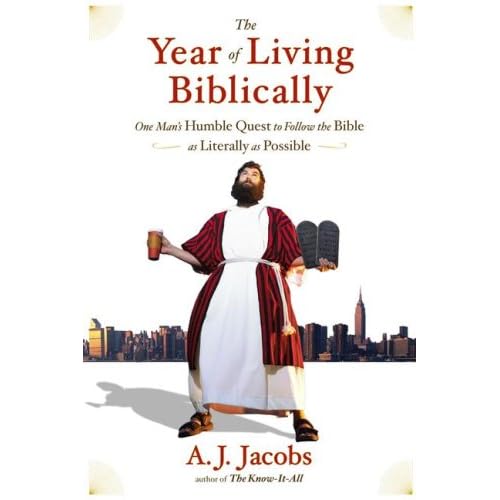
The Year of Living Biblically by AJ Jacobs.


What would your life be like if you obeyed all the commands of the Bible? What a really neat, quirky question! Okay, what a ridiculous question. Ridiculous that I would ask you since this is the very cry of your heart. Ridiculous that a Newsweek writer would find it fresh and intriguing in an intellectual sense. Here is the article I am referring to.

Listen to the tagline of the article "What if you spent one year following every rule in the Bible? A. J. Jacobs did exactly that." Right, here's an unbeliever who's actually going to obey it all for even a day, let alone a whole year!?!? No offense, it just isn't possible. Not for you or me and not for the author. For the author's reputation sake: he admits in the article that he didn't keep them all even for one day.


But it does bring up two interesting questions. First, which of the over 630 commands are we required to obey as Christians? Second, can we keep all the ones that are required -and if not - how diligent are you to obey? It won't happen by accident.

The final question (and probably the most important) we need to talk about is: should I grow out my beard like Jacobs'?


Labels:

Thursday, September 13, 2007

When I'm Not Around

My daughter just turned one. All you who know her, see her as an incredibly pleasant and smiley baby girl. The deep-dark-secret is that she is fooling you all. At home, she is really fussy. I know everything said on the Internet lasts forever (as the experts say) so sorry girly ... i hate to embarrass you.

Just now, Evelyn was playing on the kitchen floor while I read Ray Bertolet's blog and while Rachel was in the bano. She was pleasant and even cheery. As soon as Rachel came out of the bathroom, Evelyn started fussing and reaching out for mama to hold her. As Nathaniel always said as a baby, "hold you me!"

So Rachel commented after this fuss: "Why is she only pleasant when I'm not around?" Believe you me, it is frustrating and stressful to hear the wailing of a baby. But in this moment, I thought about things from my baby girl's perspective. She is thinking "I happiest when I'm in my mama's arms."

All this got me thinking about us and the Lord. There are times in my life that I am close to the Lord and there are times when my spiritual vitality is dry and my soul is hungry for Him. When I see Him moving in my life, or in the lives of those around me. I realize that He is there and I do all I can for Him to hold me and stir and fill my aching soul. When I am blind to His quiet working, when I don't notice His presence and workings, I am content to busy myself in the matters that surround me.

Like my baby girl, I am pleasant when I forget about my God but when I see Him, all I want is for Him to be close with me. May I put away the propensity to be content apart from Him. May my spiritual eyes be restored to full sight. May I always see His movings. May I always hunger and even ache for closeness to Him. May I be eager to hear the whispers of love and assignment from His Spirit.

Labels:

Monday, September 10, 2007

God at Work in China

The Facts, Ma'am, Just the Facts

Read this article by Pastor John Piper: "Mark This Day and Marvel at the Work of God." This past Friday marked the two-hundreth anniversary of the first Protestant missionary to enter China. I want to encourage you to read Piper's comments, but for now, I'll quote the missionary's prayer. His name was Robert Morrison and he wrote in his journal to the LORD: "“May he be the first-fruits of a great harvest, one of millions who shall come and be saved on the day of wrath to come." God, teach me and my church and my nation to pray this way.


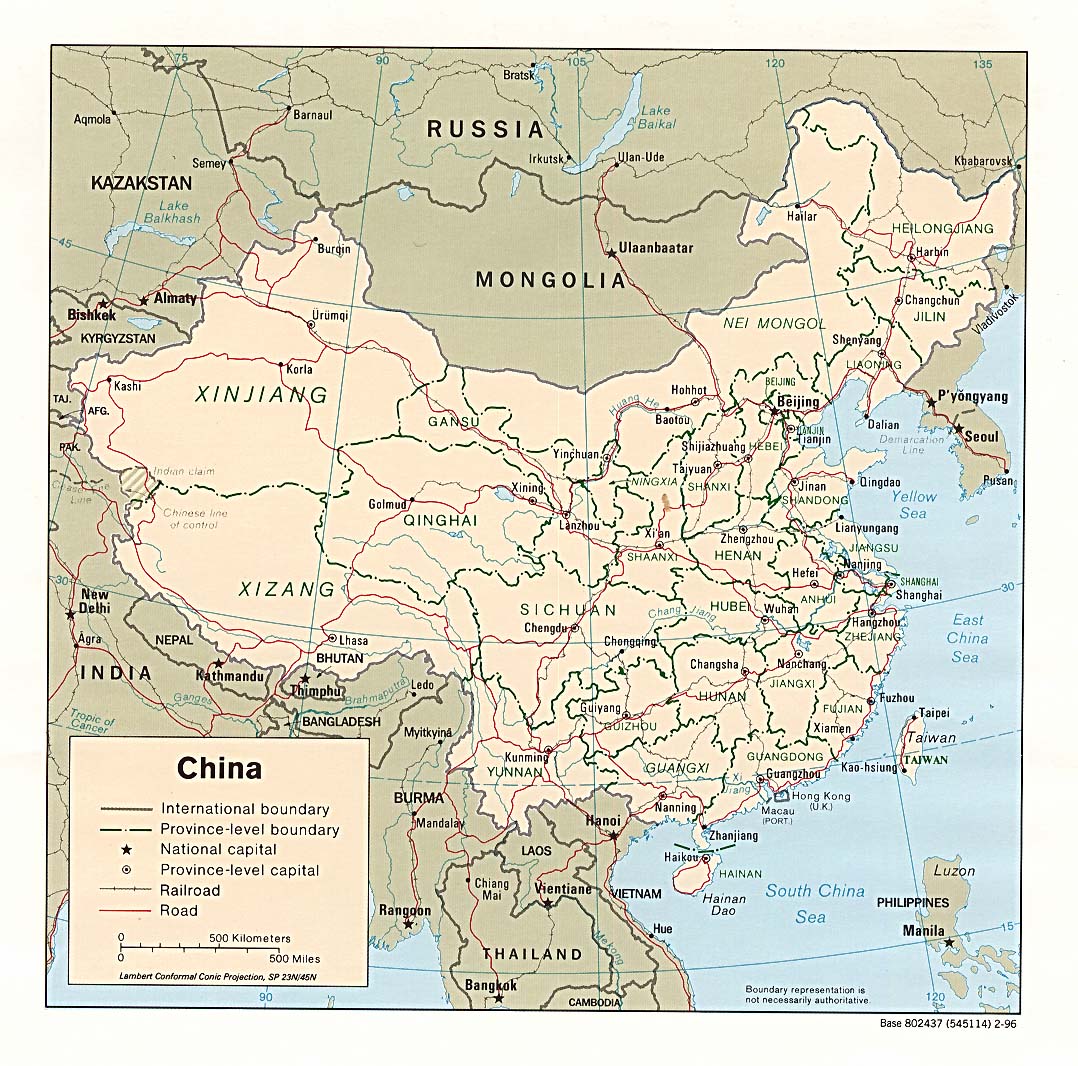
Where China is Today

There are 111 million Christians in China. 90% of them are Protestants. A CLOSED NATION IS THE THIRD LARGEST CHRISTIAN NATION IN THE WORLD!!!! We have GOT to pray more for God to work in this world.

Do you think He is waiting for us to ask before He works? It reminds me of that poignant statment by Jesus "When the Son of Man comes, will He find faith in the world?" (Luke 18:8) He says this right after preaching on the need for intense, consistent prayer for God to act on one issue.

Labels:

Thursday, September 06, 2007

Sweet ... at First


The Text

Revelation 10:9-10

So I went to the angel, telling him to give me the little book. And he said to me, "Take it and eat it; it will make your stomach bitter, but in your mouth it will be sweet as honey." I took the little book out of the angel's hand and ate it, and in my mouth it was sweet as honey; and when I had eaten it, my stomach was made bitter.


Some Thoughts

How would you describe your devotions today? this week? this month? Would you say they give you warm fuzzies all the time? Feeling close to Jesus is a good thing and I wouldn't want to rob someone of it. My belief is that sometimes, devotions need to hurt. Have your devotions ever hurt?


The saying goes: no pain, no gain. I'm not ready to buy it hook-line-and-sinker, but the axiom: pain makes you grow, I believe that is true. How does this relate to devotions? Sometimes we need the comfort and affection of Jesus in our one-on-one times with Him. But sometimes, as my dad says, we need a yardstick whacked over our heads. Sometimes it should be sweet to the taste. Sometimes it should be bitter in our stomach. Don't feel like you devotion times are no good when you feel far from Him. We are only ever far from Him when WE move far from Him. He always stays on course; we are the ones that meander all over the thicket on either side of the path. When devotions hurt, it's often because we are being convicted of wandering.


This is why, in general, I am not crazy about these devotional booklets. They certainly have their place in life, but when was the last time you read one and it said something tough to swallow? Too often, I fear, Christians stuff themselves on spiritual junk food (all fluff and no subtance) instead of truly craving spiritual meat (sometimes tough to chew, but always beneficial). I'm not indicting all devo books, I'm just throwing an idea out there.


When John ate the scroll, it tasted sweet at first, but became sour later on. Many times it feels good to start in on devotions and you're reading and all of a sudden, it hits you like a ton of bricks: I fall short. I don't measure up. It becomes bitter. Don't stop your devotions! This is the ministry of the Spirit in your life. He convicts in order to fix, He fixes in order make you like Jesus. This is His job. And you'll never end up like Jesus until you surrender to His convicting. Let Him work... He's a professional!

Labels:

Neat Labor Day Blog


I was reading my favorite blogs and came across this one about Labor Day and eternity. Will we work in heaven? Read this blog by Mike Metzger over at Vanguard Church.

Labels:

Saturday, September 01, 2007

Taking the Lord's Name in Vain

The Text

"You shall not take the name of the LORD your God in vain, for the LORD will not leave him unpunished who takes His name in vain." Exodus 20:7


Some Thoughts on This

In a few months, we will be doing "Tough Sayings" in Evening Worship. The first will be the Unpardonable Sin that Jesus speaks of in the Gospels. Essentially, the unpardonable sin is ascribing to Satan the works of the Holy Spirit. Is this command in the Big Ten related at all to the Unpardonable Sin?


Enter, Dennis Prager

I heard on the radio this week a Jewish man speaking about war atrocities. His thesis was that atrocities in the name of secular ideology far outweigh the atrocities in the name of religious idealogy. Hitler, Stalin, Mao, Pol Pot, and other 20th century dictators kiled more for their purposes than all of the crusaders throughout the millenia. Then he came to the current atrocities perpetrated by Islamic extremists. They kill in the name of their god. He said they are breaking this Big Ten. Taking God's name in vain means (to the Hebrew mind) to do evil for God and call it good. I had never heard that before.


Aw, Jeez...

According to this scholar, "oh my G-d" and "J-sus Chr-st!" when you are shocked, hurt, etc may be wrong, but it isnt part of the Big Ten. He says God is big, noble and He wouldn't vaporize you for that. But what He cannot abide is when truly wicked people make religion and make Him appear to be advocating the sick and truly evil behaviors of those spokesmen. I get it. That certainly is more evil than "goodness gracious!"


It's Your Turn

Your thoughts on the Third Commandment?

Labels: ,

Wednesday, August 29, 2007

WWJB ???

I Found This Cool Bumper Sticker?

Dean's Beans has this bumper sticker out to promote their fair trade organic coffee. At first, I just laughed about it. I'm not one to bicker about religious humor as long as it isn't sick humor (oxymoron?). Then it made me start to think... what would Jesus brew for real?!?

By all accounts, brewing the roasted fruit of coffea arabica began at least 1000 years ago, but probably not 2000 years ago. So Jesus more than likely did not brew anything. But the question remains: would He drink coffee today and if so, what brand?


What's the Point?!?!

You could read a lot into this bumper sticker. My read is that it is a push for their fair-trade coffee. Jesus could only enjoy a cup-o-joe if it wasnt made with the sweat and tears of slaves. The emperialist Tim says I wouldn't drink anything made from sweat and tears cuz it would be pretty salty. The Christ-like Tim says most of the coffee we drink IS made by oppressing the local farmers of the third world. We get upset when we hear Kathy Lee Gifford atrocities about little kids in Hondurna sweat shops. But we also don't audit the life stories and situations of the coffee farmers.


I'm not trying to be a bleeding-heart lib, nor am I trying to make Jesus out to be simply a 21st century ethics professor. Jesus taught the poor and downtrodden to be happy with their wage and to not get Him involved in sorting out their financial dealings with other people. He only made it a point to pay taxes when others made a fuss over it.


Should we be concerned with the source of what we put down "the hatch?" What would Jesus brew? Our coffee comes from Latin and South America, Africa, and Southeast Asia, and some from Arabia. The farmers hardly break even on the transaction with the traders who act as middle men between the roaster (Folgers, Starbucks, and all the other brands) and the farmers. They can't argue with the traders who would just go to the next farm down the way. The trader wants to buy low and sell high. All-in-all we buy our $4 cafe lattes with chocolate drizzled ontop and the farmers see pennies for their work.


This brings us to Fair Trade coffee (and other products are moving this way too). You pay more for the coffee so that the farmer can actually move up the economic ladder or at least keep their heads above the water. According to Dean's Zine, Fair Trade farmers make three times what they would have otherwise made. Would Jesus insist on only drinking Fair Trade coffee? Or would He turn a blind eye to the subjugation of hard working (South) Americans?


At the end of the day, the sticker is less funny than I first thought...

Labels: