Bible Think Tank

This site is designed to help you interact with others about God's Word. I further some thoughts we developed during morning and evening gatherings at church. I have my NT translations from the original Greek to English. Also, I have book reviews and other current events.

Tuesday, June 03, 2008

Filling Up Christ's Afflictions - Col. 1:24

Colossians 1:24

Greek

νῦν χαίρω ἐν τοῖς παθήμασιν ὑπὲρ ὑμῶν καὶ ἀνταναπληρῶ τὰ ὑστερήματα τῶν θλίψεων τοῦ Χριστοῦ ἐν τῇ σαρκί μου ὑπὲρ τοῦ σώματος αὐτοῦ ἐστιν ἐκκλησία

(Click on a word above to have Zack Hubert at Re:Greek parse it for you)

Greek Translation
Now I rejoice in the sufferings for your sake and I fill up the deficit of Christ’s afflictions in my flesh for the sake of His body, which is the Church.


NIV
Now I rejoice in what was suffered for you, and I fill up in my flesh what is still lacking in regard to Christ’s afflictions, for the sake of His body, which is the Church.

Accurately obscures the sufferings at the beginning of the verse. Later, Paul fills it up in his body, so most likely this first sufferings does refer to himself, but NIV rightly keeps it the way he wrote it. The “what is still lacking” is bad not only because the still isn’t there in Greek, but also because Paul is filling in the gap presently, so it no longer is still lacking… Paul is filling it. Although pathemasin at the beginning and thlipseon in the middle can both be translated “afflictions,” the NIV did good to translate them differently to keep the distinction between Paul’s sufferings and Christ’s afflictions… that they are separate trials in intensity and in affect.

NASB
Now I rejoice in my sufferings for your sake, and in my flesh I do my share on behalf of His body, which is the Church, in filling up what is lacking in Christ’s afflictions.

Interprets the sufferings as mine. Not at all sure where NASB gets the “in my flesh I do my share.” This is a rare case in which NASB does some inappropriate interpretive work. Major word order problem bringing the “in my flesh I do my share on behalf of His body, which is the Church” to the middle rather than keeping it at the end as it is in the Greek. Diddo NIV in keeping “sufferings” and “afflictions” distinct.


KJV
Who now rejoice in my sufferings for you, and fill up that which is behind of the afflictions of Christ in my flesh for His body’s sake, which is the Church:

Thoroughly unreadable in the 21st century. Diddo NASB: interprets the sufferings as mine. Granted we are separate by 400 years, but it sounds in 21st century English like KJV is saying Paul’s sufferings are behind Christ’s afflictions. That is to say, his don’t measure up to His. But this is not what the Greek says. The Greeks says “I supply the deficiencies of Christ’s afflictions.” Consequently this "behind Christ's" is what Tyndale (1534) translated it as. Tyndale's verse 24 is "Now joy I in my sufferings which I suffer for you, and fulfil that which is behind of the passions of Christ in my flesh for His body's sake, which is the congregation." He got the distinguishing of Paul's and Christ's afflictions wrong where he translates both as "passions." I like what Tyndale wrote in commentary. "Passions or sufferings of Christ: is the passions which we must suffer for His sake. For we have professed and are appointed to suffer with Christ. John 20, as My Father sent Me, so send I you." That we don't suffer FOR Him, but we suffer WITH Him. Consequently, Wycliffe (1388) got it right and I will add that below...


Wycliffe (1388)
And now I have joy in passion for you, and I fill those things that fail of the passions of Christ in my flesh for His body, which is the Church."

He got the passion wrong in making both sufferings and afflictions the same English word. Making two English words distinguishes them just as Paul distinguished them in Greek even though they have the same range of meanings. And now I wonder if it is not Christ's afflictions on Calvary that are deficient, but His afflictions in my body. That is to say, Christ is suffering in my body as I am wounded for His Name's sake. But His suffering is not yet complete... His plan is that I suffer more and that He in me suffer more. The Wycliffe translation puts more likeliness in this than the other English translations. I suppose the possibility is there in the Greek. See my Greek translation at the top.


ESV
Now I rejoice in my sufferings for your sake, and in my flesh I am filling up what is lacking in Christ’s afflictions for the sake of His body, that is, the Church.

Diddo NASB and KJV: interprets the sufferings as mine. Word order issue, moving “in my flesh” to the front of the phrase. Overall, pretty good translation. Diddo NIV, NASB, and KJV distinguishing “sufferings” from “afflictions.”


NLT
I am glad when I suffer for you in my body, for I am completing what remains of Christ’s sufferings for His body, the Church.

The temporality of the rejoicing is not in the Greek, as it is in James 1:2 (hotan, whenever). “I suffer” in the Greek is a noun, not a verb… should be “in the sufferings” rather than “when I suffer.” Puts “in my body” with “the sufferings” rather than with the “I am completing” as it is in the Greek. Gets the meaning pretty good with “I am completing what remains of Christ’s sufferings for His body.” That is, the thrust of Paul’s comment is to say Christ is in me, ministering to His Church through me. As he got done saying in the previous section v13-22, that Christ is the first place, He wins everything, He is responsible for all good. And then anticipates well what Paul will say in v27 that the mystery is “Christ in me” and in v29 “His power working mightily in me.” This is the least possibly-arrogant of the major translations. Paul wasn’t really bragging in the Greek, but in English you could (and you’d be wrong) accuse him of boastful pride. NLT captures best the heart of his comment. Kudos!


See my comments on the whole section of 1:23-29 here.

Labels: , , , ,

Monday, June 02, 2008

An Anthem Passage for the Missional Church

Colossians 1:23-29 was the passage we looked at this past Sunday night. The title of my message was On Mission with Jesus. (Audio and Notes)

There are many passages that herald the Missional Church movement. This one falls somewhere are the top of that list. Listen to the words of Paul:

"23 if indeed you continue in the faith firmly )established and steadfast, and not moved away from the hope of the gospel that you have heard, which was proclaimed in all creation under heaven, and of which I, Paul, was made a minister. 24 Now I rejoice in my sufferings for your sake, and in my flesh I do my share on behalf of His body, which is the church, in filling up what is lacking in Christ's afflictions. 25 Of this church I was made a minister according to the stewardship from God bestowed on me for your benefit, so that I might fully carry out the preaching of the word of God, 26 that is, the mystery which has been hidden from the past ages and generations, but has now been manifested to His saints, 27 to whom God willed to make known what is the riches of the glory of this mystery among the Gentiles, which is Christ in you, the hope of glory. 28 We proclaim Him, admonishing every man and teaching every man with all wisdom, so that we may present every man complete in Christ. 29 For this purpose also I labor, striving according to His power, which mightily works within me."

Here we see the assignment of our mission (v23b), the extent of our mission (v24), and the enabling of our mission (v27b, 29).


I. The Assignment of Our Mission (v23b)

How far must the message of Jesus go? To the whole world. Paul said it had been proclaimed to all creation under heaven. Elsewhere, he says he completed the task of preaching to all the world. To Timothy, he says in 2 Tim 4, that "I have fought the good fight, I have finished the course, I have kept the faith." What are we doing to get the Word out to the rest of creation? As God said of David when he was buried "David, having served God's purpose in his generation, was buried with his fathers" (Acts 13:36).


II. The Extent of Our Mission (v24)

The group last night had lots of curiosity about the seeming audaciousness of Paul's claims in verse 24. That Paul filled up what was lacking in Christ's afflictions. What is lacking in Christ's sacrificial death? Is the messenger part of the salvation? There are a lot of possible interpretations but the best is that Jesus suffered to accomplish our redemption, but the Christian suffers to take the message of that redemption to particular believers. Not that we all suffer, but it is the willingness to do whatever it takes for His good news to get out.

See my translation work on this verse here


III. The Enablement for Our Mission (v27b, 29)

How are we able to be part of Jesus' mission? How are we adequate for this high calling? The answer is in these two verses. Christ is in us. How radical that Christ is in His believers. Campus Crusade gets picked on for the diagrams, but we DO need to see that Jesus is on the throne of our hearts... that He is the LORD of our lives. Then he wraps up the section with this: "I strive according to His power, which mightily works in me." Are we able to say that the ability we have to impact our community is in His power rather than in our own? Too often, I think, we do ministry from our own thoughts, ways, power, etc.


Wrap-Up

So let's use this text within the Missional conversation. Let us get the job done in presenting every man woman boy and girl complete in Christ. Let us expend ourselves for His sake and join Him in His mission to this world. Let us do all this in His strength and not in our own.

Labels: , , ,

Tuesday, March 18, 2008

Holy Spirit's Role in Jesus' Sacrifice


The Text

Hebrews 9:13-14 "For if the blood of goats and bulls and the ashes of a heifer sprinkling those who have been defiled sanctify for the cleansing of the flesh, how much more will the blood of Christ, who through the eternal Spirit offered Himself without blemish to God, cleanse your conscience from dead works to serve the living God?"


A Brief Explanation

Our discussion this past Sunday night (3/16/2008), was on the role of the Holy Spirit in Jesus' sacrifice of Himself on the cross for our sins. Specifically in this verse, what does it mean that Jesus offered Himself "through the eternal Spirit"? What is that Spirit? Is the the Holy Spirit? Is it Jesus' soul/spirit? If it is the Holy Spirit, then what role did the Holy Spirit have in Jesus' death? The Notes are available here and the sermon audio is available here.


Barne's Notes

“Who through the eternal Spirit” —This expression is very difficult, and has given rise to a great variety of interpretation.—Some mss. instead of “eternal” here, read “holy,” making it refer directly to the Holy Spirit; see “Wetstein.” These various readings, however, are not regarded as of sufficient authority to lead to a change in the text, and are of importance only as showing that it was an early opinion that the Holy Spirit is here referred to. The principal opinions which have been entertained of the meaning of this phrase, are the following.
(1) that which regards it as referring to the holy spirit, the third person of the trinity. This was the opinion of owen, doddridge, and archbishop tillotson.
(2) that which refers it to the “divine nature” of christ. Among those who have maintained this opinion, are beza, ernesti, wolf, vitringa, storr, and the late dr. John p. Wilson. Mss. Notes.
(3) others, as grotius, rosenmüller, koppe, understand it as meaning “endless” or “immortal life,” in contradistinction from the jewish sacrifices which were of a perishable nature, and which needed so often to be repeated.
(4) others regard it as referring to the glorified person of the saviour, meaning that in his exalted, or spiritual station in heaven, he presents the efficacy of his blood.
(5) others suppose that it means “divine influence,” and that the idea is, that christ was actuated and filled with a divine influence when he offered up himself as a sacrifice; an influence which was not of a temporal and fleeting nature, but which was eternal in its efficacy. This is the interpretation preferred by prof. Stuart.
For an examination of these various opinions, see his “Excursus, xviii.” on this Epistle. It is difficult, if not impossible, to decide what is the true meaning of the passage amidst this diversity of opinion; but there are some reasons which seem to me to make it probable that the Holy Spirit is intended, and that the idea is, that Christ made his great sacrifice under “the extraordinary influences of that Eternal Spirit.” The reasons which lead me to this opinion, are the following:
(1) It is what would occur to the great mass of the readers of the New Testament. It is presumed that the great body of sober, plain, and intelligent readers of the Bible, on perusing the passage, suppose that it refers to the Holy Spirit, the third person of the Trinity. There are few better and safer rules for the interpretation of a volume designed like the Bible for the mass of mankind, than to abide by the sense in which they understand it.
(2) this interpretation is one which is most naturally conveyed by the language of the original. The phrase “the spirit”—τὸ πνέυμα to pneuma—has so far a technical and established meaning in the New Testament as to denote the Holy Spirit, unless there is something in the connection which renders such an application improper. In this case there is nothing certainly which “necessarily” forbids such an application. The high names and Classical authority of those who have held this opinion, are a sufficient guarantee of this.
(3) this interpretation accords with the fact that the Lord Jesus is represented as having been eminently endowed with the influences of the Holy Spirit; compare notes on John 3:34. Though he was divine, yet he was also a man, and as such was under influences similar to those of other pious people. The Holy Spirit is the source and sustainer of all piety in the soul, and it is not improper to suppose that the man Christ Jesus was in a remarkable manner influenced by the Holy Spirit in his readiness to obey God and to suffer according to his will.
(4) if there was ever any occasion on which we may suppose he was influenced by the Holy Spirit, that of his sufferings and death here referred to may be supposed eminently to have been such an one. It was expressive of the highest state of piety—of the purest love to God and man—which has ever existed in the human bosom; it was the most trying time of his own life; it was the period when there would be the most strong temptation to abandon his work; and as the redemption of the whole world was dependent on that act, it is reasonable to suppose that the richest heavenly grace would be there imparted to him, and that he would then be eminently under the influence of that Spirit which was granted not “by measure unto him.” notes, John 3:34.
(5) this representation is not inconsistent with the belief that the sufferings and death of the Redeemer were “voluntary,” and had all the merit which belongs to a voluntary transaction. Piety in the heart of a Christian now is not less voluntary because it is produced and cherished by the Holy Spirit, nor is there less excellence in it because the Holy Spirit imparts strong faith in the time of temptation and trial. It seems to me, therefore, that the meaning of this expression is, that the Lord Jesus was led by the strong influences of the Spirit of God to devote himself as a sacrifice for sin. It was not by any temporary influence; not by mere excitement; it was by the influence of the “Eternal” Spirit of God, and the sacrifice thus offered could, therefore, accomplish effects which would be eternal in their character. It was not like the offering made by the Jewish high priest which was necessarily renewed every year, but it was under the influence of one who was “eternal,” and the effects of whose influence might be everlasting. It may be added, that if this is a correct exposition, it follows that the Holy Spirit is eternal, and must, therefore, be divine.

Hope that helps you in your study of the Holy Spirit!

Labels: ,

Monday, November 12, 2007

Cut It Out!


Introduction

This past Sunday night, we continued a series called Tough Sayings. What difficult sayings does the Bible make, what things seem confusing or contradictory? Let's answer them... that is the point of this series. So here is a seemingly contradictory practice:

In one instance, Paul circumcises a disciple of Jesus (Timothy) in another instance Paul boldly refuses to circumcise another disciple of Jesus (Titus). How can it be okay to do this and at the same time not be okay to do this? If we are no longer under the Law then why would he do this? If we are still under the Law then why would he refuse this?


Paul Circumcises Timothy

Acts 16:1-4

"Paul came also to Derbe and to Lystra And a disciple was there, named Timothy, the son of a Jewish woman who was a believer, but his father was a Greek, and he was well spoken of by the brethren who were in Lystra and Iconium. Paul wanted this man to go with him; and he took him and circumcised him because of the Jews who were in those parts, for they all knew that his father was a Greek. Now while they were passing through the cities, they were delivering the decrees which had been decided upon by the apostles and elders who were in Jerusalem, for them to observe."

My Comments

Who was Timothy? He was half-Jewish and half-Greek (v1). His dad was a Greek (v3) and so Timothy had never undergone circumcision. His mother and grandmother were OT believers when the Christians came to town with the news of Jesus death and resurrection. They mom and grandmom came to Christ and both raised Timothy in the Scriptures. He became a follower of Jesus too (v1). Paul saw great potential in this young man and wanted him to join Paul's ministry team. Paul's basic strategy was to go into a new town and enter a synagogue to present the Good News of Jesus to the Jews in the town. If and when they reject, then Paul would move on to the Gentiles of the town. This is important because in the text Paul recognizes that there were many Jews in the area nd they all knew that Tim's dad was a Greek and that Timothy would not have been circumcised. Paul's ministry would be hindered among the Jews if they knew of Timothy's faux paux. So to remove the road block to the Gospel, he cut away any distraction (a big fat pun intended).


Paul Refuses to Circumcise Titus

Galatians 2:1-6

"Then after an interval of fourteen years I went up again to Jerusalem with Barnabas, taking Titus along also. It was because of a revelation that I went up; and I submitted to them the gospel which I preach among the Gentiles, but I did so in private to those who were of reputation, for fear that I might be running, or had run, in vain. But not even Titus, who was with me, though he was a Greek, was compelled to be circumcised. But it was because of the false brethren secretly brought in, who had sneaked in to spy out our liberty which we have in Christ Jesus, in order to bring us into bondage. But we did not yield in subjection to them for even an hour, so that the truth of the gospel would remain with you. But from those who were of high reputation (what they were makes no difference to me; God shows no partiality)--well, those who were of reputation contributed nothing to me."

My Comments

Here we see something very different. Here are Jewish men who are allegedly followers of Jesus (v4) but Paul asserts that they are not in fact born again. Anyway, they insist that Titus become circumcised and that one is not born again unless they have become a Jew first. But Paul? He does not yield in subjection for even an hour! Why does he refuse now in something he unreservedly did with Timothy? These people would want the distortion of the good news. Paul is concerned that the only thing in the Gospel is the Gospel. Christianity plus anything is not Christianity.


Who Do We Care About?!?

The main point of this dichotomy in Scripture is this: I will do all that I can to remove any distractions from the unbeliever on their path to salvation. I will do all that I can to trip up a Christian who is in error, I cannot allow a Christian to remain ignorant AND arrogant.

You're trying to live for Jesus, you've organized some things in your life that insulate you from unbelievers, are these good boundaries or are they hindrances to their salvation?


Hmmm...

Labels:

Saturday, September 01, 2007

Taking the Lord's Name in Vain

The Text

"You shall not take the name of the LORD your God in vain, for the LORD will not leave him unpunished who takes His name in vain." Exodus 20:7


Some Thoughts on This

In a few months, we will be doing "Tough Sayings" in Evening Worship. The first will be the Unpardonable Sin that Jesus speaks of in the Gospels. Essentially, the unpardonable sin is ascribing to Satan the works of the Holy Spirit. Is this command in the Big Ten related at all to the Unpardonable Sin?


Enter, Dennis Prager

I heard on the radio this week a Jewish man speaking about war atrocities. His thesis was that atrocities in the name of secular ideology far outweigh the atrocities in the name of religious idealogy. Hitler, Stalin, Mao, Pol Pot, and other 20th century dictators kiled more for their purposes than all of the crusaders throughout the millenia. Then he came to the current atrocities perpetrated by Islamic extremists. They kill in the name of their god. He said they are breaking this Big Ten. Taking God's name in vain means (to the Hebrew mind) to do evil for God and call it good. I had never heard that before.


Aw, Jeez...

According to this scholar, "oh my G-d" and "J-sus Chr-st!" when you are shocked, hurt, etc may be wrong, but it isnt part of the Big Ten. He says God is big, noble and He wouldn't vaporize you for that. But what He cannot abide is when truly wicked people make religion and make Him appear to be advocating the sick and truly evil behaviors of those spokesmen. I get it. That certainly is more evil than "goodness gracious!"


It's Your Turn

Your thoughts on the Third Commandment?

Labels: ,

Tuesday, August 21, 2007

God's Presence with Us - Exodus 32-34


God of Grace when We are Wicked
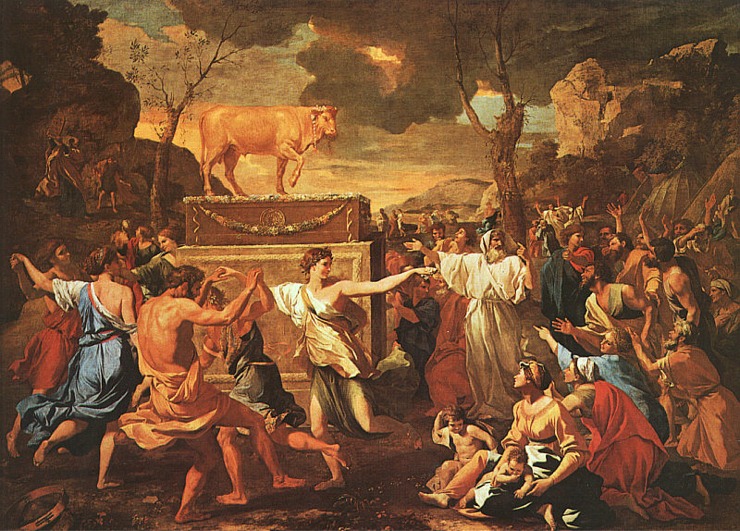
Last Sunday night, we talked about the God of grace, in our series, What God Is Like. We began our study looking at a conversation God had with Moses. It happens right after the people of Israel worship the golden calf at Mount Sinai. God set them free from slavery in Egypt, parted the Red Sea so that they could escape the Egyptian army, fed them and gave them water to drink in the middle of the desert, and their reaction is: "God has left us and killed Moses (neither is true) so let's make our own god that can lead us to the Promised Land."


A Divine Conversation
That is when God begins saying many new things to Moses. Reading from Exodus 32:34 "But go now, lead the people where I told you. Behold, My angel shall go before you." Whereas He used to say "I will lead you to a good land" now He says "you lead them" and "I'll send an angel to guide you there." Later He says in chapter 33, "if I would go up in your midst for one moment, I would destroy you" (v5). We begin to think that God is giving up on these people. Have you ever invested tons of time into a project and in the end, realize that it isn't going to pan out like you thought it would. Maybe a relationship that you dumped a lot of time and energy into and the two of you just couldn't fit well together. These things are common in our lives, but it seems to us that the Lord would be different. In our minds, God never starts something He can't finish and He never met a person He couldn't befriend. Now we read this passage in a careful way and the idea begins to enter our minds: "is God really that different than us?" "Is He bound to the same limitations in relationship that we are?" He concludes in 33:5 "let Me see what I am going to do with you." It is almost as if He needs to think about it for a while.


Your Presence with Us
So Moses, in his conversation with God, says "See, You say to me, ‘Bring up this people!’ But You Yourself have not let me know whom You will send with me" (Ex 33:12). Then he says "If Your presence does not go with us, do not lead us up from here. Is it not by Your going with us, so that we, I and Your people, may be distinguished from all the other people who are upon the face of the earth?" (Ex 33:15-16). Moses wants to know how he is supposed to plug away. How could he do this huge task without God being with him.


Time for Honesty
Two things: 1) I can't do this life without God reigning in my heart and impulses and 2) every chance I get, I try to run my own life on my own terms. I have tried to make the best out of my life and screwed it up horribly. That is the whole point of salvation. We don't really need to convince people of their sin, everyone knows we are desperately needy. But now that God woke me up, cleaned me up, set me on His pathway, and guides me toward godliness: why am I so hungry to start making my own choices and not seek His choices for me? Do I think on the inside that salvation is just a way of starting over again? He fixed me and now says, "try again?" I know Biblically that that view is wrong, I know from this and every other passage in the Bible that we can't do it on our own. In my favorite cartoon show, Strong Bad created this one-legged dog character called Lil' Brudder who's catch-line is "I can do it on my own."


The Friend of God
Moses truly is the friend of God. Me, not so much. He is the first to say "if You don't go, I'm not going." We would tend to say, "thanks for not wiping us out, if You are going to bring us in with Your angel, could we, like, get a piggy-back ride, our feet are sore." We tend to think God's blessings are good enough. I don't need God's presence, all I need is His blessings. The fact is: the deeper into friendship with Him we go, the quicker our heart is to want Him. Thank God that I am not bound to remain in this state of mind. He will change my heart to want Him more than His blessings. A relationship with God is a lot like any human friendship. God has frequently portrayed His relationship with His people as a marriage relationship. Read Hosea or Ephesians 5:22-33 to see this illustration in action. So when I was first dating the woman that would later become my wife, I really liked kissing, I really liked being a boyfriend, "attached" and not "single." These are fringe benefits of the relationship, they are not the be-all of a dating relationship. Now that I am married, I see (and see more each day) that knowing this one person so closely and being one with that one person is FAR more valuable to me than the fringe benefits of the relationship.


A Closing Prayer
"LORD! Teach my heart to want You and nothing else. I don't want heaven, or mansions over the hilltop, or a Promised Land, or to be healthy wealthy and wise, or an inspiring church, or a good pastor-teacher, or manna or quail. I don't want the things that You provide, the things that surround You, the things from You. I Want You and Your presence."

Labels: